

Fluid Mastering is an independent mastering company owned and run by Tim Debney & Nick Watson, both former Mastering Engineers at London’s renowned Townhouse Studios.
Fluid Mastering opened its first mastering studio in Hammersmith, London in 2007 and soon established itself as one of the leading mastering facilities in the UK, catering both to major labels and established artists as well as to independent and self-funded projects.
In 2021 Fluid Mastering doubled its capacity, building new studios in Bristol and Surrey, leaving behind the original London premises. Each of the two new studios is equipped with the same high-end gear that formed the core of the original studio in W6, including PMC BB5 XBD-A monitoring, Bryston Amplification, Prism ADA and outboard by Manley, Maselec and Rupert Neve. Scroll down for more details.
Tim & Nick each have over 30 years experience, mastering music in every style from traditional Rock, Jazz and Folk through to more contemporary electronic Dance, R&B and Pop.
At Fluid Mastering, we combine top-tier studio quality with a cost-effective approach, giving us the flexibility to meet our clients’ needs while keeping costs reasonable. Whether you're a new artist preparing to release your first project or an established producer looking for a reliable UK mastering solution, we’re here to help.
Unsure about your mixes or next steps? Get in touch; we’re only too happy to provide feedback and guidance, at no extra charge.
The services on offer include both attended and unattended (online) mastering, vinyl mastering, catalogue re-mastering, stem mastering, editing and restoration. For further details make a selection from our MASTERING INFO menu.
Fluid Mastering now operates from two locations: Bristol (Fluid West) and Surrey (Fluid South). Each studio is led by one of our highly experienced mastering engineers. To learn more about the engineer based at each location, click the button for Fluid West or Fluid South below. If you’d like to view an overview of the equipment used across both studios, please scroll down this page.
Monitoring
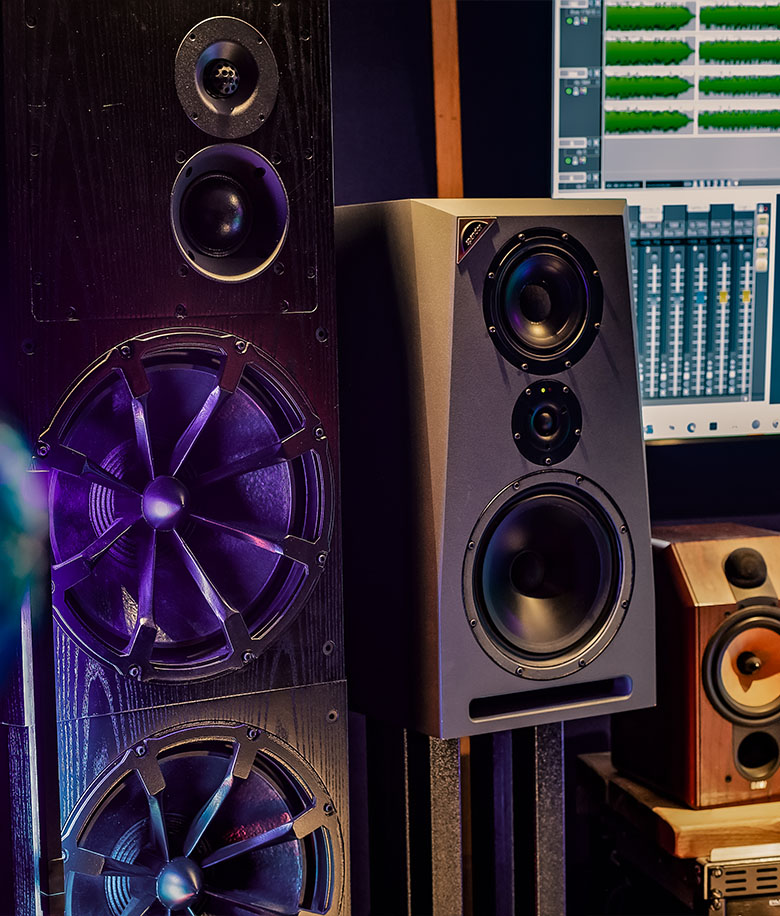
PMC BB5-XBDA With Bryston Amplification
The BB5 was the first commercially available reference loudspeaker made by PMC and remains their flagship product to this day. Combined with the XBD bass extension and over 2kW per channel of Bryston amplification, this is the most popular monitoring configuration used in the UK’s leading mastering studios and was the only choice for us, providing incredible accuracy at all levels.
Mastering monitors must be as neutral as possible; not flattering the mix at all but revealing any issues that could affect clarity and hinder a track’s performance across different playback systems. Our PMCs enable us to hear both the intended and unintended effects of every process we apply, ensuring even the smallest adjustments are clearly audible. This also gives us the confidence to make bold, adventurous choices where appropriate.
A/D/A Conversion
Prism Sound “Dream” ADA-8XR
The most critical process in most mastering scenarios is A/D/A conversion — whether converting analogue mixdowns to digital, or vice versa for analogue processing before returning to digital.
Our main choice for this is another flagship product, the ADA-8XR by Prism Sound; probably the most popular top-shelf A/D/A converter in the world. With its rock-solid clocking and unparalleled performance, it does nothing to the sound except ensure a transparent conversion process. The result is that the audio sounds exactly the same as it did before conversion — you can’t ask for more.
Mastering Console and Routing
SPL DMC & SPL Hermes
At the heart of our mastering process is the SPL DMC mastering console; which gives us control over all the analogue signals coming in and passing through the system, and routing the results back to the A/D converter and to our chosen monitors.
Paired with the DMC is the SPL Hermes mastering router which provides instant re-patching and bypassing of the outboard hardware, with a useful parallel processing option for two of the eight available processors.
Both the DMC and Hermes are built with SPL’s proprietary 120V technology, allowing unprecedented headroom and low noise, for pristine fidelity no matter the configuration.
Analogue Outboard
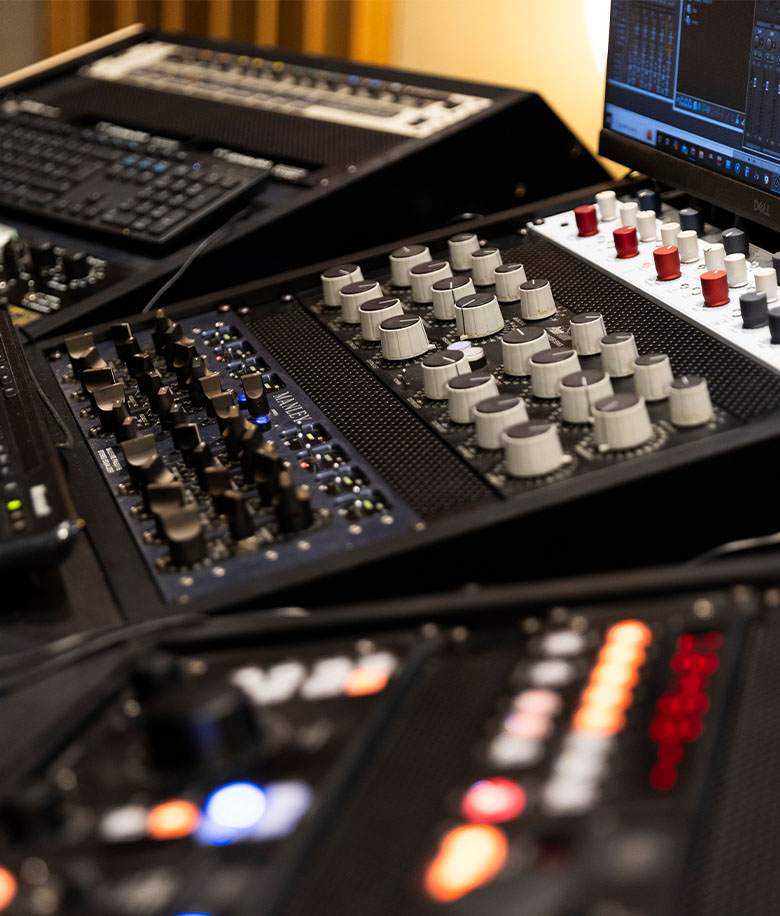
Prism Maselec MEA-2 Stereo EQ
Manley Massive Passive Stereo EQ
Rupert Neve Designs – Portico II Master Buss Processor
Although digital plug-ins have advanced significantly and can emulate analogue gear, top-tier mastering studios, including ours, prefer using the real thing. True analogue equipment offers a three-dimensional sound that’s hard to match, and our selection includes some of the most popular high-end units alongside a few rarer gems.
Our primary analogue EQs — the Prism MEA-2 and Manley Massive Passive — each bring unique qualities. The MEA-2 provides precision and transparency, with a super sweet top end, while the Massive Passive adds character, warmth, and more dramatic tone-shaping options when required. For compression Rupert Neve’s Portico II can really bring a track to life and is literally much more than just a compressor, with the added benefit of the Silk circuit which allows for the controlled application of 2nd and 3rd harmonic distortion from the output transformers which characterises the vintage Neve sound.
The Digital Audio Workstation (DAW)
SADiE 6 with Cedar Re-Touch and De-Click
Our masters are compiled and edited on the SADiE 6 system from Prism Sound, which provides total transparency and exceptional audio integrity, particularly when summing in-the-box. It’s fast, intuitive, and has never failed us in years of mastering work.
One plug-in that we find invaluable, and that runs on our SADiE system, is Cedar’s renowned and latterly much copied Re-Touch. Originally designed for audio restoration, and to take out unwanted extraneous noises from location recordings etc., Re-Touch provides an editable spectrogram of a chosen segment of audio, and can probably be most easily described as “Photoshop for sound”. There is barely ever a session that goes by without our needing this fella at least once, whether it be to remove some clicky spittle from a particularly close vocal, or just to smooth over a dodgy edit. We use Re-Touch to fix the things you thought you couldn’t fix; it’s an amazing piece of kit whose applications are seemingly infinite and its ability to blow the minds of our attending clients make it one of our very favourite gadgets.
In addition to these common tools, each studio also features its own range of gear as chosen by the engineers.